ENG

The Crimean Tatar language has been granted official status three times over the past century: first under Stalin, then during the years of independent Ukraine, and now, after Russia declared it one of its official languages.
Three political regimes, which succeeded one another on the peninsula and differed in almost everything — ideology, borders, and even the very understanding of who Crimea historically belongs to by right — agreed to include the same provision in their constitutions. And just as synchronously, they did everything to ensure that this provision remained nothing more than words on paper.
This is the paradox itself; it's not in the fact that the language is dying. Dying languages are by no means a rarity in the world. What is rare is when a language that has been officially recognized in the constitutions of three different states for over a hundred consecutive years is losing its speakers faster than languages that have never been officially recognized by anyone.
So, the issue isn’t the absence of a law. The issue is why the law was written in the first place.
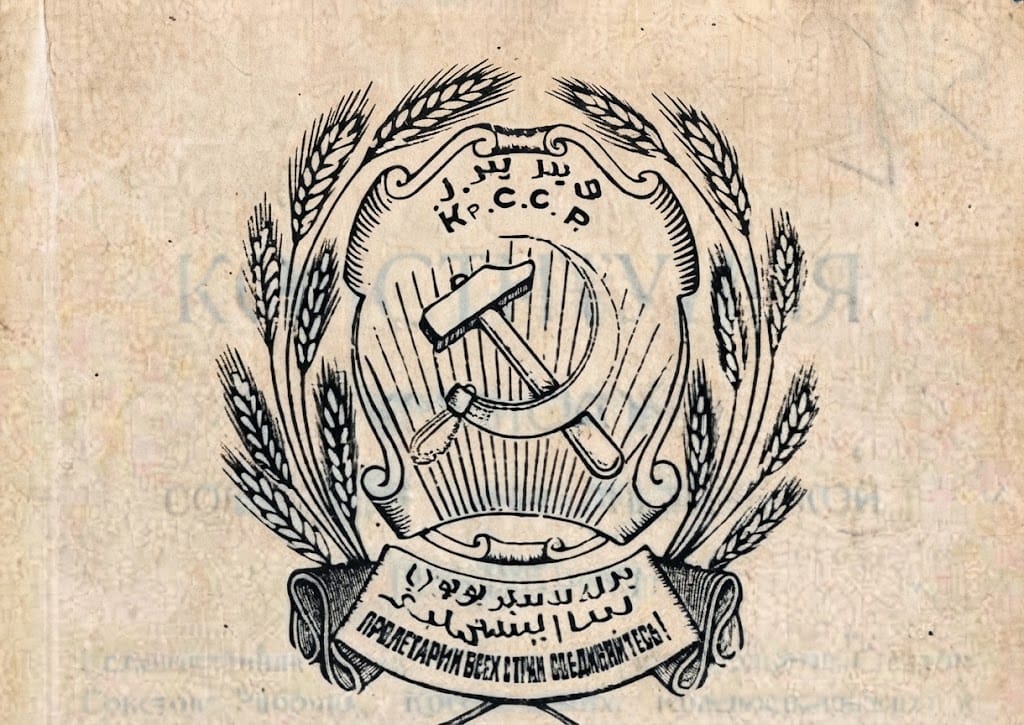
The Crimean Tatar language was first granted official status in the constitution of the Crimean ASSR in 1921. And back then, it wasn’t just for show. Documents, court proceedings, signs, and civil registry records — all of these existed in Crimean Tatar alongside Russian, and by 1941, there were 386 schools on the peninsula where instruction was conducted in the native language, attended by virtually the entire Crimean Tatar child population of Crimea. This was not an act of charity on the part of the Soviet authorities, but a calculated move: at that time, Moscow needed to demonstrate loyalty to the Turkic-Muslim peoples for the sake of an alliance with Kemalist Turkey. As soon as this foreign policy need disappeared — and at the same time a plan for deportation took shape — the writing system was changed twice: first to the Latin alphabet, then to unmodified Cyrillic. The intellectual class, capable of defending the language, was physically exterminated, and in 1944, the entire Crimean Tatar infrastructure — schools, two teacher-training colleges, the Institute of Language and Literature, and libraries— was shut down in a single campaign. All books were burned. The status remained. The language — no.
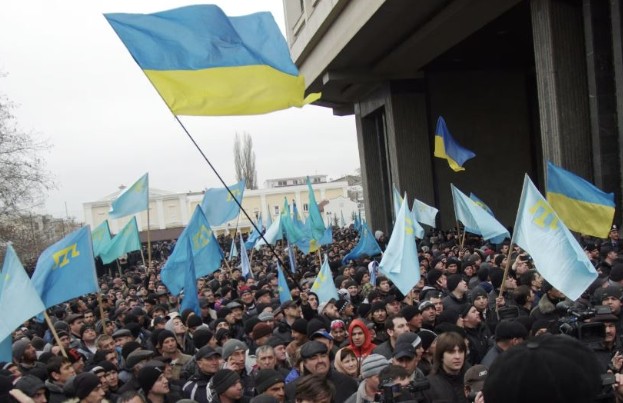
This mechanism was triggered a second time in independent Ukraine. From 1995 to 1998, the autonomous region’s documents were indeed published in three languages. But then the Crimean Tatar parliamentary faction — just 14 deputies out of 100 — pushed through an official decision to return the Crimean Tatar language to the Latin alphabet at the cost of a hunger strike. The decision became legally binding and was… completely ignored — not a single school, ministry, or textbook ever switched to the Latin alphabet, because while parliament passes laws, the executive branch — which simply did not need this decision — is responsible for allocating the budget and distributing textbooks. At the same time, in reports to the UN and the Council of Europe, Kyiv confidently reported on the number of children studying their native language. The figure was impressive and bore no relation to reality. 61.8% on paper versus 29.8% in reality — this is not a statistical error; it’s simply that the intended audience was different: not the Crimean Tatars, but Geneva and Strasbourg.
This is the third time the Crimean Tatar language has been granted official status since the occupation of the peninsula. A 2002 Russian law explicitly prohibits any alphabet other than Cyrillic for the official languages of the republics. Today, out of sixteen schools where Crimean Tatar is officially designated as the language of instruction, it is actually taught in fourteen, while 44% of school-age Crimean Tatar children have no access whatsoever to learning their native language in any form. Where it is taught, there is no legally mandated minimum curriculum in principle. The concepts of a “national school” or “in-depth study” are simply absent from the law. And the decision — whether it will be one hour a week or half an hour a year, a required subject or an elective — is entirely at the discretion of the principal. This is precisely why the language can be easily eliminated: not by repealing a law or imposing a ban, but simply by failing to find a teacher or allocate time in the schedule.
Of course, there will be those who object: after all, there are schools, there are clubs, newspapers are published, and dance troupes perform. Yes. But that is precisely the point of the complaint, not its refutation. The token presence of a language, coupled with a complete lack of obligations and an environment in which it can be developed, is not an intermediate stage on the path to revival, but a fully-fledged, functional model for managing a dying language. Forty-five minutes of Crimean Tatar versus over two hundred minutes of Russian per week — this is not an oversight, but a ratio that can be maintained indefinitely without consequences, because the law requires recognition of the language but does not require accommodating it in the schedule or taking measures to ensure its genuine development.
Three states that succeeded one another on Crimean soil and built their legitimacy on entirely different foundations arrived at the same conclusion: a status without infrastructure is cheaper than a ban and safer for one’s international reputation. A ban provokes protest. Recognition on paper removes the issue from the agenda — both for activists and for UN monitoring commissions, which verify the existence of a law rather than the number of hours a child spends speaking their native language or the presence of a linguistic environment in an adult’s life.
All of the above is a condensed version of a much more extensive study. For many months, I collected and cross-checked this data — constitutions from three different periods, school statistics, and demographic tables — to ensure that accuracy was not lost amid the emotions. The full study, complete with sources, dates, and figures, has been published in Turkish and English on an academic platform. For anyone who values primary sources, please refer there.
A century of the Crimean Tatar language’s history, as documented, proves that its legal status was never a tool for salvation. It was merely a tool for delay. For a hundred years in a row, three states formalized the language’s rights on paper, while simultaneously doing everything in their power to ensure it was not spoken anywhere except in the kitchen and at family gatherings. And then they publicly feigned surprise (while secretly rejoicing) that the kitchen and family gatherings could not accomplish a task that only schools, the streets, the airwaves, and the state apparatus were capable of. A language deprived of its natural environment for a century cannot be revived through the efforts of memory alone and a few printed publications. It either lives and thrives where it can be spoken aloud and everywhere, or it remains a line in the constitution — until that line outlives the last person who still remembers why it was written.