ENG

On May 18, 1944, an entire people was deported from Crimea. This was not an “act of military necessity against collaborators with the occupiers,” as Soviet propaganda claimed. It was a deliberate act of genocide that killed tens of thousands of people and rewrote not only the history of the peninsula but also its geography: hundreds of Crimean Tatar place names were erased from maps.
Eighty years have passed, but the people who returned to their only homeland are still forced to prove their right to it. When the average Ukrainian hears about this, they usually wonder: “Cultural autonomy, indigenous people status, a legally recognized representative body, funding for schools — all of this is already in place. What else do you need?”
It sounds perfectly reasonable and rational. But behind this rationality lies a dangerous misrepresentation. Because the Crimean Tatar people lack the most essential thing — the institutional, constitutional right to participate in the governance of their historic homeland. For decades, Ukrainian political discourse has oscillated between two extremes: sentimental rhetoric about the “Crimean Tatar brothers” and their tragic fate, and a deep-seated, instinctive fear of the phrase “national-territorial autonomy.”
This fear is a heavy burden of post-Soviet thinking, in which any manifestation of an indigenous people’s agency is perceived as a threat rather than as a foundation of security. The paradox is that from 1991 to 2014, Crimea was already an autonomous region. But it was an autonomy controlled by the pro-Russian majority, the Soviet nomenclature, and security forces subordinate to Lubyanka. As a result, it was precisely this autonomy that surrendered the peninsula in 2014 without a single shot being fired.
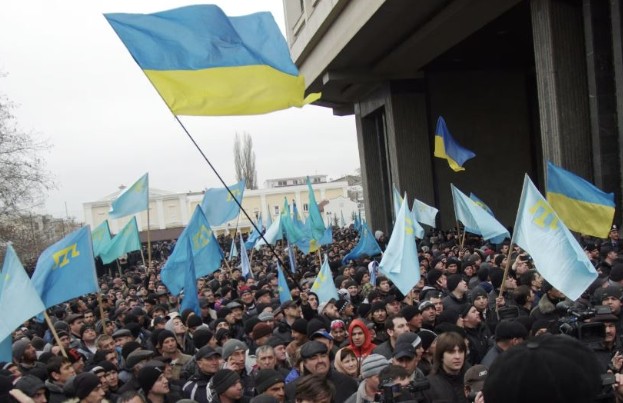
Throughout all 23 years of its existence, the Crimean Tatars were the main force that saved Crimea from being completely absorbed by Russia. And it was the Crimean Tatars who, on February 26, 2014, upheld the peninsula’s Ukrainian status outside the walls of the Crimean parliament, while the Ukrainian state apparatus in Simferopol was falling apart.
Opponents of Crimean Tatar autonomy constantly put forward a mathematical argument: “But you make up only 12–15%! Wouldn’t that be discrimination against the Ukrainian majority? How would you explain this to a soldier from Poltava or Lviv who is shedding blood for the liberation of Crimea?”
First, the figure of 15% itself is not a demographic coincidence but a direct result of the policy of extermination that the people have endured since 1783, starting with the first annexation of Crimea. To demand that the victim accept their situation as an “objective reality” is to legitimize the consequences of genocide. The rights of indigenous peoples exist precisely because the question of a nation’s survival cannot be decided by a simple majority. When population size becomes the primary criterion, the rights of an indigenous people can be forgotten. It will always be in the position of a minority, wondering whether the majority will allow it to preserve its identity.
Second, the answer lies in the very essence of decolonization under international law. The Hungarians have Hungary, the Poles have Poland, and the Ukrainians have a vast state stretching from the Sian to the Don. The Crimean Tatars do not have a single square meter of land outside Crimea. Ukraine has already taken an important step in this direction. A 2021 law officially recognized the Crimean Tatars as an indigenous people and enshrined their right to self-determination within Ukraine, as well as their political status and self-governance in internal matters. This is in line with the UN Declaration on the Rights of Indigenous Peoples, which recognizes the right to autonomy or self-governance in internal matters, while explicitly excluding the undermining of states’ territorial integrity.
Thus, the dispute is not between “a united Ukraine” and “separatism.” It is about whether self-determination will become a real mechanism or remain a mere declaration on paper. The Ukrainian state has legitimate grounds to fear conflict, as the Constitution explicitly enshrines the unity and indivisibility of the territory, defining Crimea as an integral part of the state. But the autonomy of an indigenous people and an ethnic state are entirely different things. Autonomy does not make Ukrainians or members of other communities “guests” on the peninsula, nor does it make the Crimean Tatars superior or better. It does not abolish unified citizenship, shared constitutional rights, democratic elections, or the rule of law.
It merely grants the indigenous people the right of veto and special powers in matters directly related to their survival. Land use, development, preservation of cultural heritage sites, the environment, historical topology, and the linguistic environment — these are the guarantees of a people’s survival. In particular, this ensures that decisions about the future of this land will never be made without the involvement of those who have been systematically and regularly displaced from it.
This model has long been tested in global practice. The political agency of the Sami in Norway or the Māori in New Zealand is viewed not as a privilege, but as the norm under European law and the restoration of justice. Recognizing the political agency of the Crimean Tatars is neither a concession to “historical grievances” nor an emotional debt for 2014. It is the most reliable safeguard against Russian revanchism for centuries to come. A people who survived 1944 (and much oppression before that) are incapable, both physically and mentally, of becoming an instrument of the empire.
It is time for Ukraine to overcome its post-Soviet fear of its own diversity. Trust in the indigenous people of Crimea is a sign of the state’s strength, not its weakness. If Ukraine wants to gain not merely the return of its territory after de-occupation, but a stable, secure, and European Crimea, this key issue of decolonization must be resolved now, once and for all.