ENG

A Crimean car owner’s morning begins with the question, “Where can I get hold of a couple of litres?” Several Telegram channels, apps and chatbots provide the answer. If you’ve got the time, you’ll get the fuel.
“If you’re ready to set off at any time of day or night and know the city well, you can basically fill up every day. Petrol turns up here and there. On average, you end up spending three or four hours queuing, but that’s better than having no petrol at all,” says a repair mechanic from Simferopol. He can’t do his job without a car.
There is no fuel available for sale in towns; it is only available on the motorways. The delivery situation is worst in logistically isolated regions – Dzhankoy, Sudak and Chornomorske. But even there, many people find a solution through grey-market supply schemes, where a whole lorry, without reaching a petrol station, is unloaded under cover of night straight into the tanks of residents. No vouchers, no QR codes and no triple mark-ups.
“A friend messaged me today: ‘Look for some containers; the lads are bringing a couple of cubic metres tomorrow, just for our own people...’ Our close-knit networks really get on their nerves; I noticed this straight away after the occupation. Apparently, there’s a mutual support network here from our births; everyone knows each other, and there’s always a brother-in-law or cousin who’ll lend a hand. No matter how hard they try to break it down, it doesn’t work,” shares a resident of the Pervomaiskyi district.
As if to confirm his words, a video has recently appeared on social media pages linked to the FSB and the Centre for Countering Extremism, featuring an apology from a man detained for selling petrol and fuel cards on the black market. Previously, people were forced to make such video confessions for their pro-Ukrainian views. Now, residents of the peninsula are being made to understand that helping one another will also be punished.
“It’s absolutely laughable: all those ‘vata’ who enthusiastically cheered on every ‘zhdun’ video and demanded they be dealt with are now sitting without petrol, watching on those very same social media pages as they’re being deprived of their last chance to get fuel anywhere. And they’re being deprived by the very same people who are using the very same methods that they themselves have fervently supported all these years. That’s where the boomerang hit them completely out of the blue,” quips a student from Sevastopol.
The relentless crackdown on ‘hoarders’ is actually being carried out to create an even greater shortage, according to a pensioner from Simferopol who used to work for one of the fuel companies. The frenzied demand fuelled by such ‘campaigns’ is only growing, and those behind them are well aware of this, he is convinced.
“The scarcer the fuel, the higher the demand. Higher demand means higher prices. And the ‘bigwigs’ get a cut from every litre. As long as they can blame it all on the treacherous Ukrainians, they’ll keep the shortage going by any means necessary and profit from the panic and high prices,” says a resident of Simferopol.
According to him, most of the online groups where Crimeans share information about fuel availability at petrol stations are flooded with posts from undercover agents who, posing as ordinary car owners, are on the lookout for ‘speculators’. Moreover, these messages are often found alongside adverts from fraudsters offering to sell vouchers or fuel cards at quite reasonable prices.
“Don’t make the same mistake I did! I run a business, and in situations like this, you have to look for solutions, even risky ones. I took a chance and paid a deposit for the vouchers – fifty per cent of the total amount. I sent five thousand. And then, of course, I never saw any vouchers. And those scammers never got in touch again. I didn’t even bother going to the police, as I don’t see any point,” shares the entrepreneur from Yevpatoria.
However, in the rush to get petrol, there is a risk of losing more than just money. After all, it is not only local civilians who are queuing at petrol stations, but also ‘visitors’ in camouflage.
“The typical situation right now is this: at a petrol station where people are waiting for a tanker to arrive, there are three queues: the military, then those with ration cards, and lastly everyone else. It turns out that the military is taking our petrol, even though they should have their own. Tomorrow, the ‘second army in the world’ will start taking our bread and water, and who’s going to say anything to them?” says a farmer from Staryi Krym indignantly.
Moreover, the threat of using weapons against Crimeans in such situations seems to be becoming the norm.
“Some friends sent me the address, so I drove there, got to the front of the queue, and am waiting for the petrol tanker to arrive. There are about forty cars behind me. Then, brazenly, a ‘patriot’ pulls up without queuing, and soldiers with automatic rifles get out. They come over and say the petrol station will only be open to those with vouchers. I argued with them, saying that the petrol station had told me they’d be selling for cash, and that I’d been standing here for five hours. So one of them shoved the barrel of his rifle through my window and started shouting in a hysterical voice: ‘F*ck off before I shoot you!’” says a resident of Orlivka.
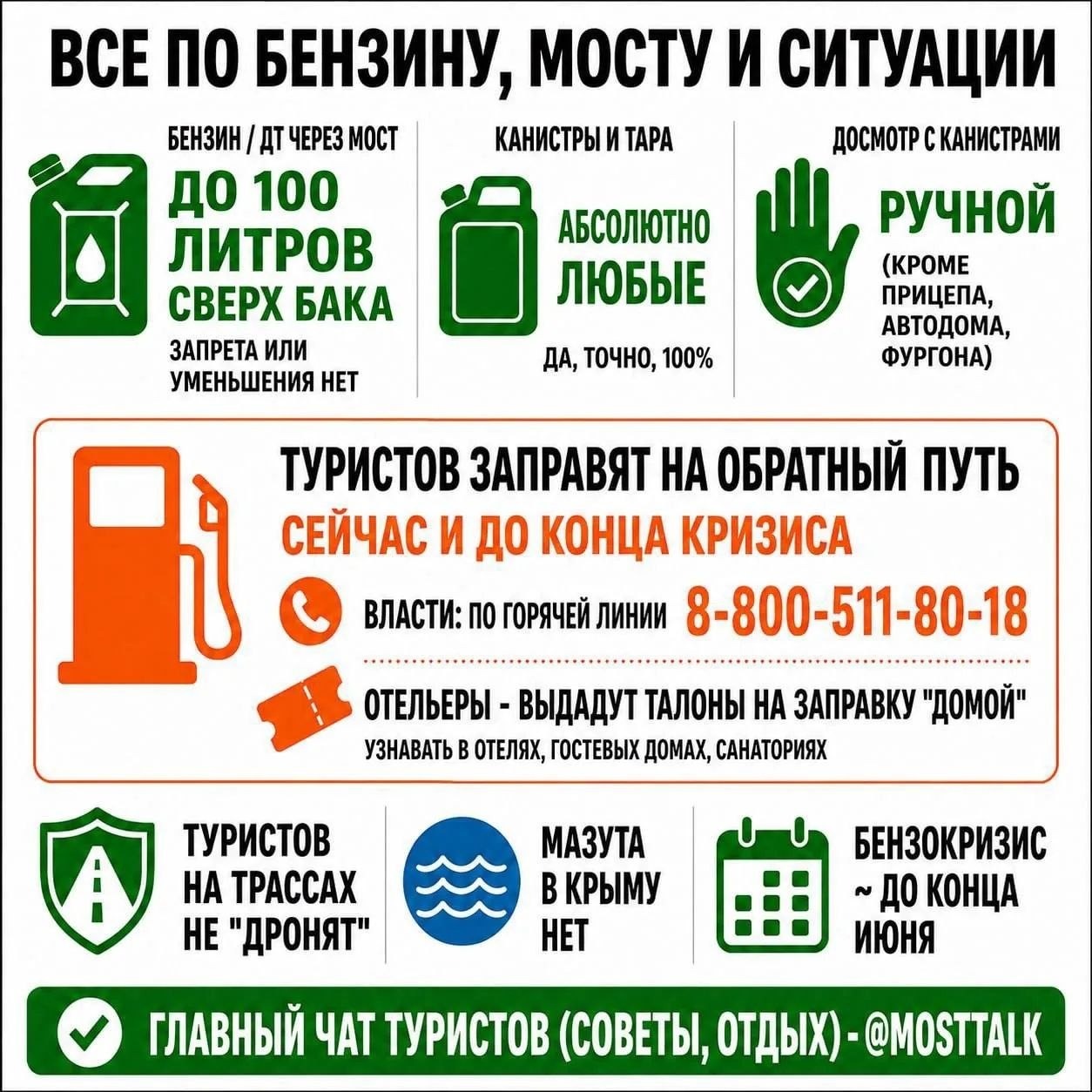
However, at the start of the summer season, some Crimeans are keen to keep the real situation as low-key as possible. One travel agency has circulated an infographic telling Russians just how hassle-free their holiday in Crimea will be this year: apparently, you can bring 100 litres of fuel in jerry cans across the bridge, the authorities and hoteliers will refuel tourists on their return, and the ‘fuel crisis’ will be over by the end of June. And all this would seem plausible were it not for one detail: the claim that there is no fuel oil on Crimean beaches is a blatant lie, and unlike the optimistic forecasts, it is easy to verify.


.jpeg)