ENG

(Intro by Tom Cooper)
Hello everybody!
I admit without any shame: have spent the last few days working on other things (‘but the blog’) - but: all the time keeping ‘half an eye’ on the continuous US military build-up in the Middle East, and the other half on Ukrainian blowing up stuff around Russia… and the Russians… ‘retaliating’.
Atop of this, the Touareg in Mali have launched one of - for this part of the World - ‘typical’ razzou operations. Still unknown as such outside relatively small circles, although practicised in very different fashion already since the mid-1980s, these are high-speed raids, based on infiltration ops, early on, aiming to collapse the centre of the enemy resistance (in this case that was one of local governor offices). This razzou has brought at least a third if not more of Mali under the Touareg control, shot down one of Russian-crewed Mi-17 helicopters, and killed the nation’s minister of defence…
Perhaps I’m simply exhausted, or distracted, but: right now I do not feel I have anything ‘useful’ to write about. Or, ‘at least nothing inspiring’. Thus, instead of wasting more of your time, let me hand over to Don.
Overview
Whenever ‘simple’ structures - such as workshops and pipelines - are damaged or destroyed by long-range Ukrainian drones, they can be rebuilt in weeks. This has been demonstrated by the oil export terminals and as well as the Atlant-Aero facility in Taganrog this week. Nevertheless, even temporary disruptions to exports and drone production are worth the cost of attacking them. However: the attacks must be continued to keep export or production levels low.
Lately, and finally, Ukraine is doing exactly that.
Attacking complex structures, such as the microchip production equipment in the Kremniy El electronics plant in Bryansk, or the machine tools of the ballistic missile plant in Votkinsk, is causing a massive problem: the Russians find it ever harder to replace and any damage. Means: such strikes are having a more durable impact.
Additionally, Ukraine continues to build obstacles that are effective in a drone-controlled battlefield. The Russians will never reach most of them but the defenses are still a wise investment.
Russia is making slow advances in Kupiansk, Sloviansk, Kostiantynivka, Pokrovsk and Huliaipole. By ‘slow’, think in terms of one or two fields in each sector. Ukrainian drones are seriously impacting Russian logistics up to 150 km away.
Chernihiv, Sumy and Kharkiv
The fighting in the north is static with low intensity attritional aerial and ground combat. The same defensive obstacles that are being erected in the south are being built in the north, and the Chernihiv sector is quiet enough for secondary lines to be built 50 km from the border while some of the front line obstacles are being built as close as 8 km to the border. Additional fortifications and obstacles were built around the cities, towns and certain villages.
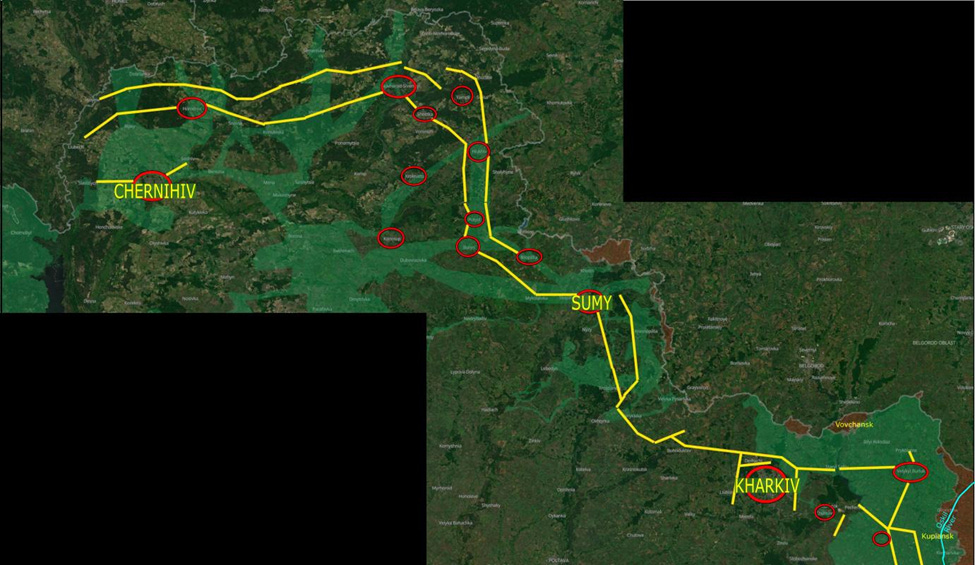
It is difficult to build extensive defenses while under fire. The drone activity in the Sumy and Kharkiv sectors is significant. Ukraine is still able to build large kill zones with movement obstacles. The cities, towns and some villages have ringed defenses, as indicated in red. The Oskil river itself is a movement obstacle and kill zone with a width that ranges from 20-50 meters. If the Russians manage to move beyond any of these obstacles, they will still be monitored by drones and many of the Russians moving across them will be killed.
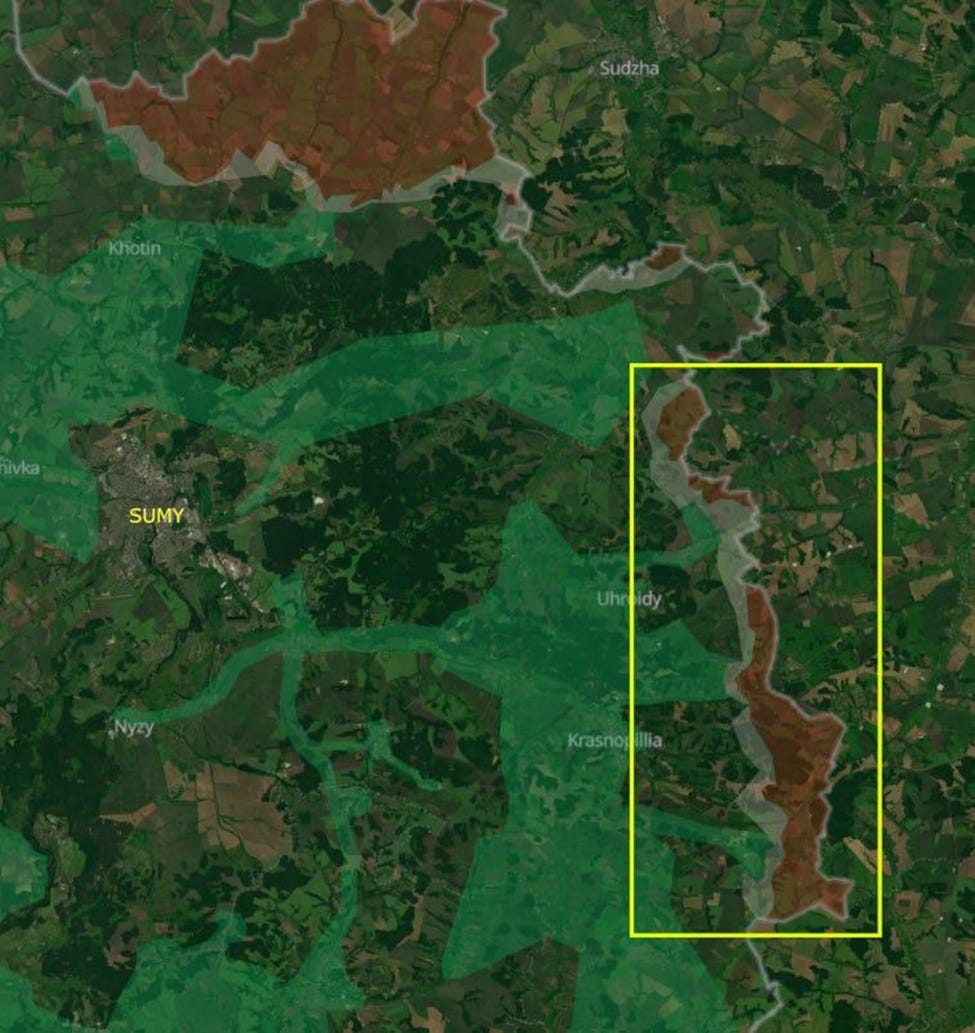
Since the last week of December, Russian forces have occupied up to 5 km of border territory east of Sumy
Most of Ukraine’s positions are set back from the border with some observation positions located in front. The Russian advances to the east of Sumy is an occupation of that gray zone. Although the low level attrition of forces is constant, there are not enough Russian forces in the north to conduct large scale offensive operations.
Should Russia choose to build up forces in this area at some later date, it would be difficult and costly to advance past the obstacles that have been built. Even if the Russians never take the cities, as they move forward, the rate of destruction of the cities will increase, so efforts will be made to keep the Russians at bay before they hit the obstacles in the kill zone.
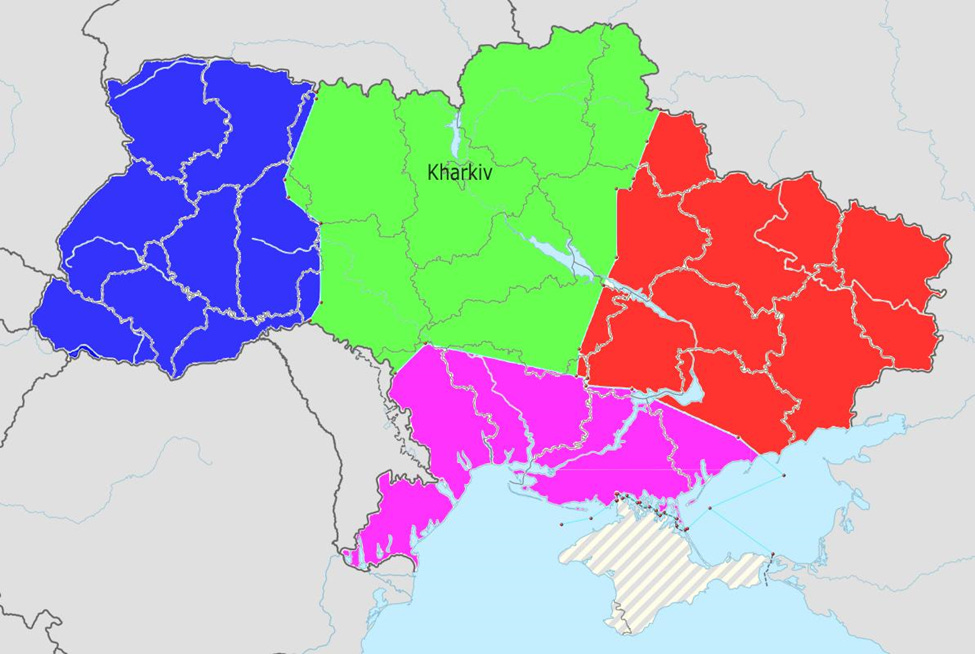
Ukraine’s air force has four commands: West (blue), Center (green), East (red), and South (pink). Ground combat in the Chernihiv/Sumy sectors is relatively quiet but Air Command Center is very active defending against Russian Geran drones and cruise missiles. A Ukrainian mobile air defense team was deployed in one of known paths of Geran drones and shot one down using a .50 cal machine gun.
Kupiansk
Both sides are constantly intercepting each other’s drones. This is the 116th Brigade intercepting Russian drones.
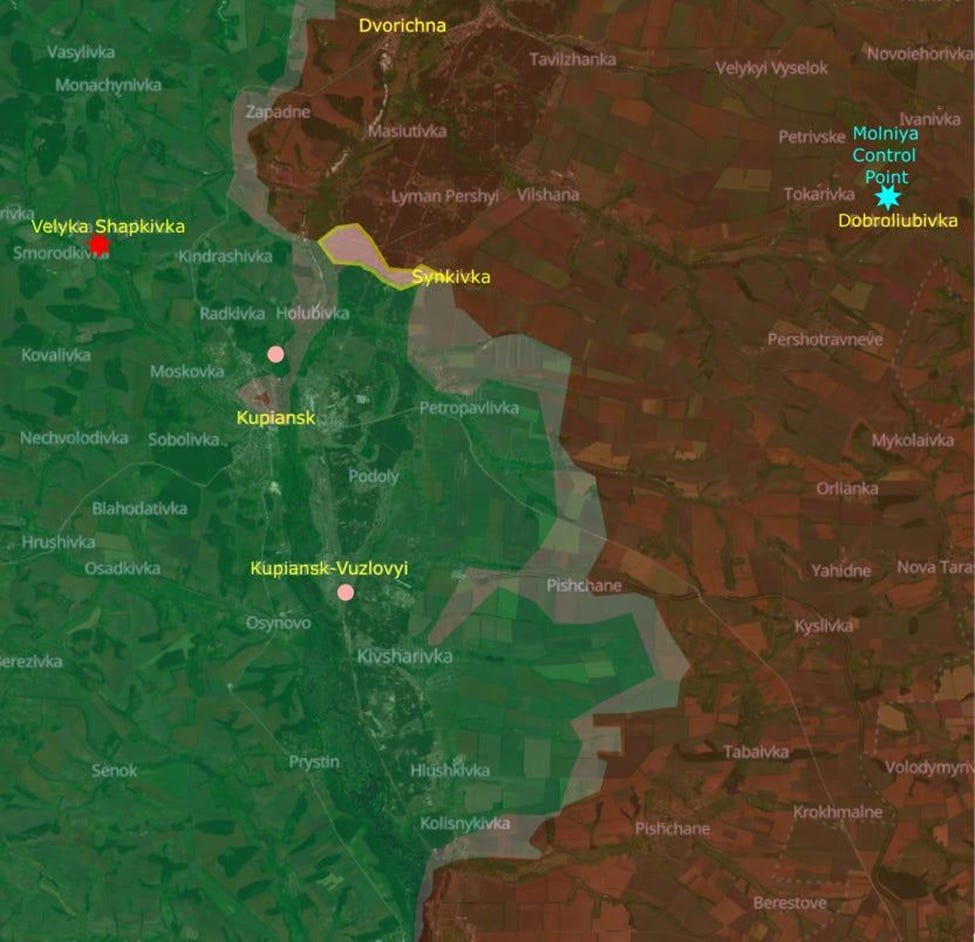
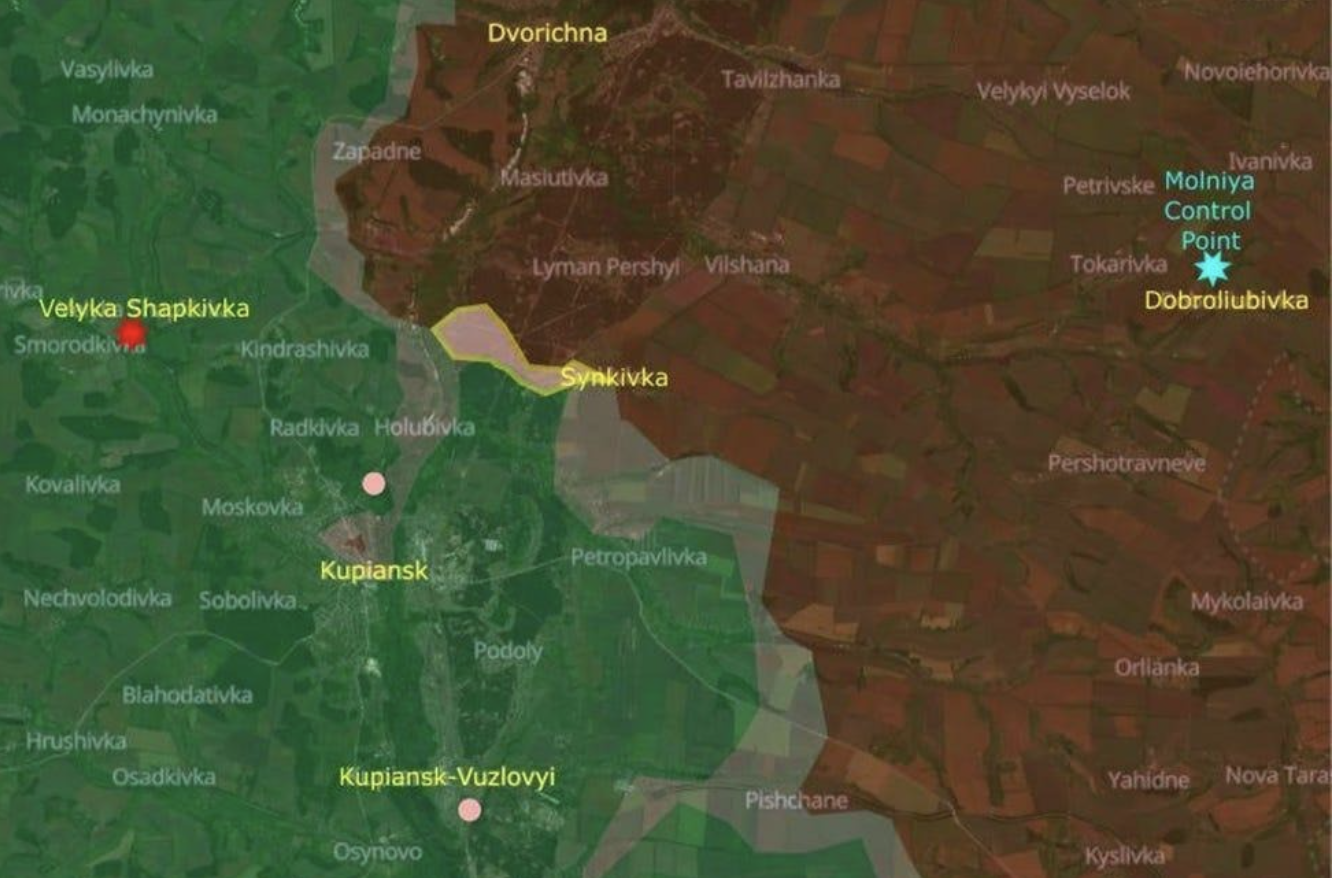
Eight Russians were seen in a damaged hospital in Dvorichna. A drone was sent in and collapsed the building. Russians in Kupiansk-Vuzlovyi were attacked. A Russian airstrike in Velyka Shapkivka, 7 km from the front line. The Molniya drone control point was attacked 15 km from the front.
Four soldiers of the 14th Brigade spent 8 months at a forward position. Food could only reach them by drones and didn’t always arrive. They sometimes went 10 or 17 days without food and drank rain water or melted snow. They lost 30-40 kg of weight, and sometimes their radio requests went unanswered. When the families posted their story online, the commander of the 14th Brigade was fired and the 10th Corp commander was demoted. The situation immediately improved. When favorable conditions allow, all four will be evacuated.
Two years ago, a stray cat and dog wandered around the front before settling in with Ukrainian soldiers of the 14th Brigade in a forward position. When the soldier taking care of the cat was wounded, he had to leave the cat behind. Drones delivered supplies to that position and the cat and dog were flown 10-12 km by that same drone to the rear. The cat will be reunited with the wounded soldier. The dog is now part of the rear area unit. Wild animals, including the rare Przewalski’s horse, are being killed by mines and other tools of war. UAnimals is a volunteer group that has saved over 10,000 animals that had to be left behind, including livestock, bees, and exotic pets.
Lyman
This is from two weeks ago but it shows the terrain around Yampil. This following map is showing the approximate positions of just the southern half of the 3rd Corps sector: one that stretches 60 km in a straight line. The 53rd, 60th and 63rd brigades are part of the 3rd Corps. The 66th and 120th brigades are attached to the corps.
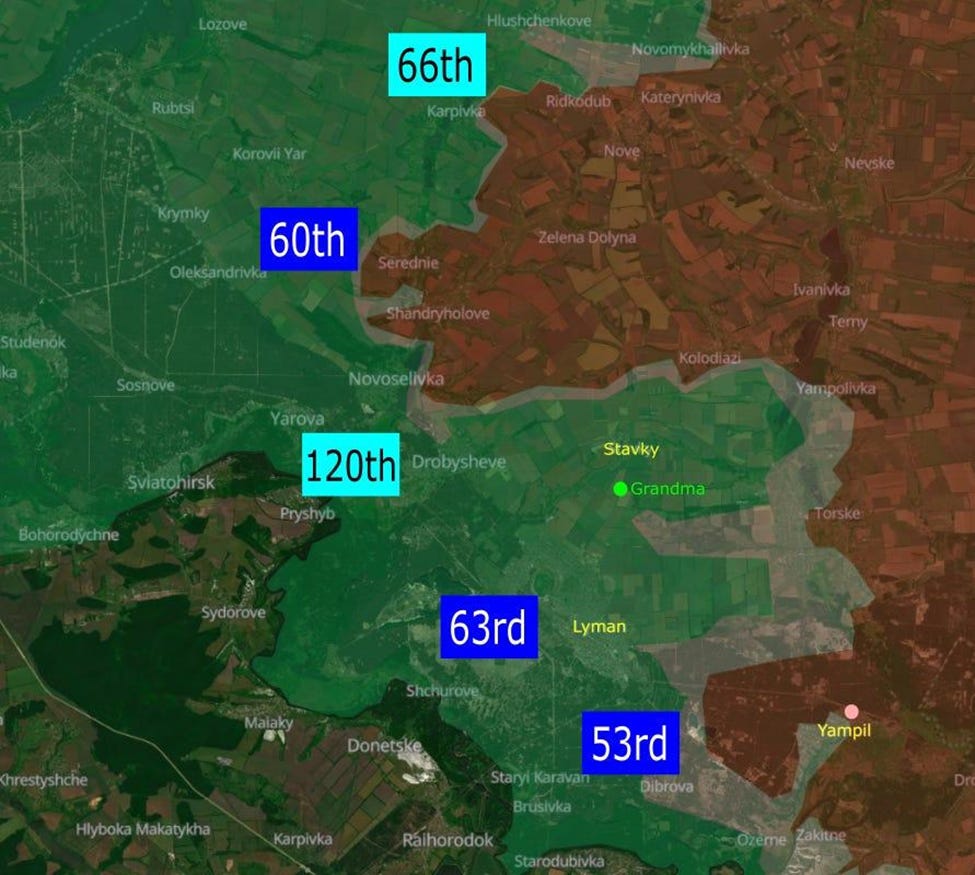
The 60th Mechanized Brigade was formed in Kryvyi Rih with untrained people off the streets in March 2022. It had to learn its lessons as it went along. It suffered its first casualties when a member was killed on 10 March, and two others that were captured were later murdered. They helped stop the Russian advance and by the end of the month started pushing the enemy back. The unit had its first break from combat when the Russians withdrew from Kherson in November 2022 and was rewarded by being deployed to Bakhmut from the end of 2022 to the summer of 2023. It was then sent to the Kharkiv sector for six months before being deployed to Kupiansk at the end of 2023. In the winter of 2024 it moved to the Lyman area.
In January 2025, the Russians began advancing in the area and the Ukrainian brigades couldn’t stop them. In July, the brigade was assigned to the newly-established 3rd Corps. Morale in the unit was poor and there was widespread desertion. After evaluating the brigades in the corps and determining their leadership and training issues, the commanders of the 125th and 60th brigades were replaced in September. Major Dmytro Rohoziuk took command of the 60th Brigade and experienced personnel from the 3rd Brigade was assigned to crucial positions, to help him change the culture.
Of the three battalions temporarily assigned to the brigade, one was re-designated a permanent battalion of the brigade and the other two were disbanded and the personnel reassigned within the brigade to fill out existing vacancies. A drone unit from the 3rd Brigade was transferred to the 60th and expanded into a drone battalion. Recruitment expanded and soldiers from disbanded international forces were sought. NCOs were worked up and trained to become the backbone of the combat units. Some personnel were unhappy with the changes and left to join the 442nd Drone Battalion in the Territorial Defense Forces.
By December 2025, the Russian advances in the area came to a halt. By January, AWOL cases in the brigade had been reduced significantly and people returned to the unit because of the way they were being treated and the trust they had in the competence of the new leaders.
When her home of 53 years was destroyed, a 77-year-old woman tried to evacuate from Stavky by walking with two canes. After the 60th Brigade saw her fall, they sent her a ground drone to carry her out.
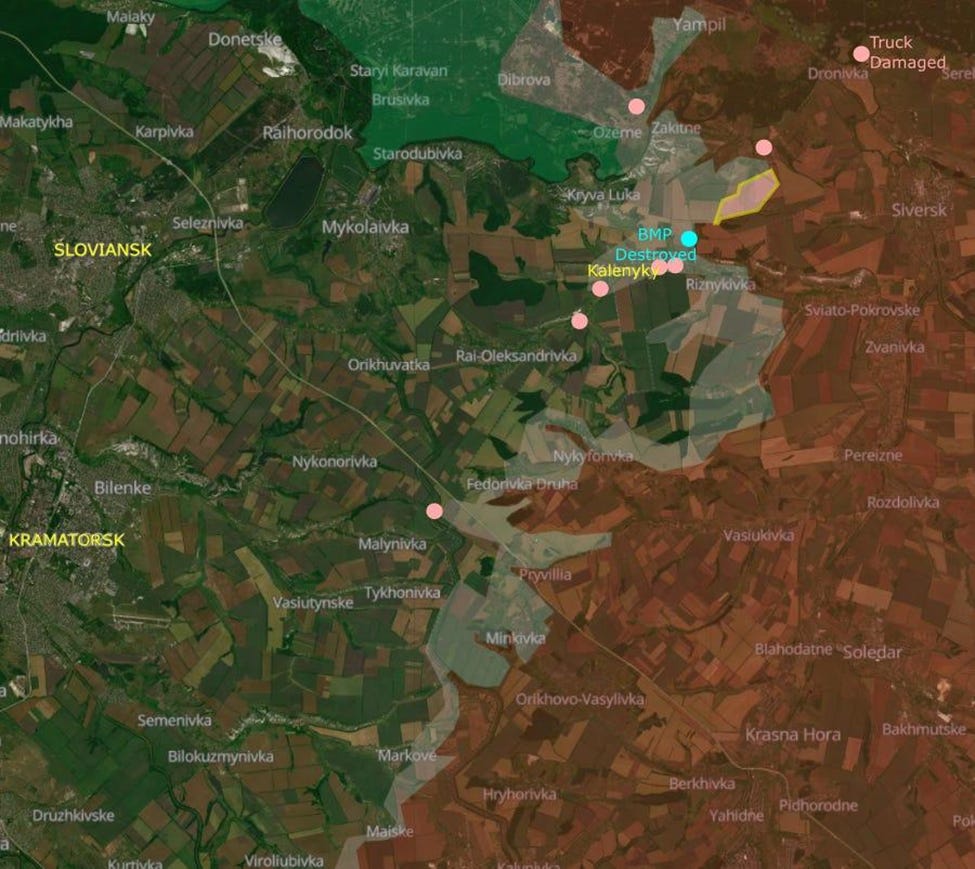
Sloviansk
Russia is still slowly advancing west of Kalenyky.
Kostiantynivka
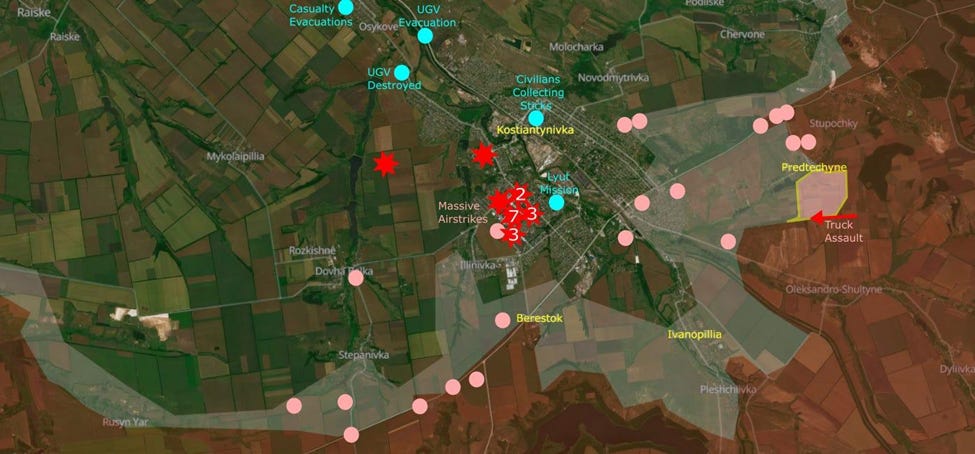
The Russian tide keeps creeping in. There were massive airstrikes in the southwestern part of the city. At least one Russian made it to that area after the bombardments.
A Russian assault in three trucks south of Predtechyne left them with 5 killed and 7 wounded.
Lyut soldiers plan a mission and use a 3D walkthrough to familiarize themselves with the terrain before conducting the mission.
A Ukrainian armored vehicle runs over an air dropped mine but keeps going. They make a speed run to pick up seriously wounded soldiers.
A UGV team diverts from their mission to evacuate a soldier from another unit.
Because of the drones, it took two days to carry a wounded soldier 12 km.
Civilians are still living in the city and collecting sticks for fuel. This is 3 km from 16 recorded airstrikes. When the Russians advance, the airstrikes will also advance.
Ukraine’s 1st Corps drones are not just attacking logistical targets around Donetsk, 60 km from the front lines, they’re attacking the Russian mobile fire teams that are trying to shoot them down.
In Bakhmut, the 56th Brigade took a tour of a partially destroyed building and found a Russian depot of an artillery piece, a motorcycle, a van with an EW device and a few looted washing machines. The gun and the van with the EW devices were hit.
This text is published with the permission of the author. First published here.




.jpeg)