ENG

(Intro by Tom Cooper)
Hello everybody!
Here we are: it’s already mid-April this year. The last weekend it was Easter for Orthodox Christians - and, that’s new: for the last two days, and nominally at least, there was a cease-fire in the War in Ukraine.
Negotiated by the UAE, and announced by Russia, this lasted 32 hours: from Saturday, 16.00hrs local time (13.00hrs GMT) until the last midnight (21.00hrs GMT). Zele reacted by proposing a longer halt of fighting - and has been turned down by Pudding: Moscow wants an overall settlement
Already by Sunday, 07.00hrs in the morning, local time, Ukrainians have reported just some 2,299 violations: the Russians blamed Ukrainians of mere 1,971 violations. As of this morning, Kyiv was crying about 7,696 violations (incl. 1,355 shellings and 6,226 drone attacks)…
With other words: actually, the war just went on. The principal difference to the last few weeks and months was that there were no major UAV- and missile attacks, and the two parties have exchanged 175 prisoners of war, plus lots of bodies, too.
Elsewhere, this weekend most of the EU (and much of NATO), plus Ukraine, were holding their breath for a different reason: because of elections in Hungary.
Meanwhile it’s sure: Orban not only lost, but Magyar’s Tisza Party has won two thirds majority. Which is ‘good’ because it’s enabling the new government to not only disable, but completely dismantle the system Orban, installed the last 16 years.
For Ukraine, it’s the fact that ‘Orban is out’ that matters the most. Foremost, this is opening the way for the EU to sponsor the government in Kyiv with €90 billion over the next two years: to keep it financially afloat.
…unsurprisingly, next to nobody is paying attention about something else.
By side that Orban - something like ‘IQ47’s spiritual father’ - lost, but the preceding election campaign in Hungary has nicely exposed few spicy details. Or at least it should have.
For example: the fact that not only IQ47 and Pudding, but also Netanyahu and his government have all positioned themselves on Orban’s side, and were meddling into Hungarian elections. Trying to influence them. I.e. that the anti-EU/NATO alliance is not limited to ‘some unimportant Hungarian politician plus his supporters in the USA and Russia, far away’, but is including Israel (and thus, and what a surprise: probably the ‘US/West’s ally’ UAE, too). Unsurprisingly, it’s not only that IQ47 dispatched his Vice to Budapest, or that Pudding made lots of promises and concessions: Netanyahu sent his son, his government openly endorsed Orban, and was closely monitoring etc…
Because I’m (quote) ‘insane’, and, definitely, a weird nerd too, this does make me wonder.
What do the people representing and supporting such behaviour - or at least ignoring it (which, actually, is including the majority of EU-governments, and the EU Commission) - then think about statements and positions of this kind?
Ah yes: it’s ‘anti-Semitic’ and/or anti-democratic and/or multi-polar-world and/or left-wing-sissy to post such a link… right?
…hm… no idea why, but this is beginning to remind me of all those ridiculing the Russians when they empty their tanks- and artillery-boneyards to replace losses in Ukraine, but are not ridiculing the USA when this starts returning to service KC-135s stored at its own boneyards to replace… erm… it was no ‘losses’ - from the war with Iran…
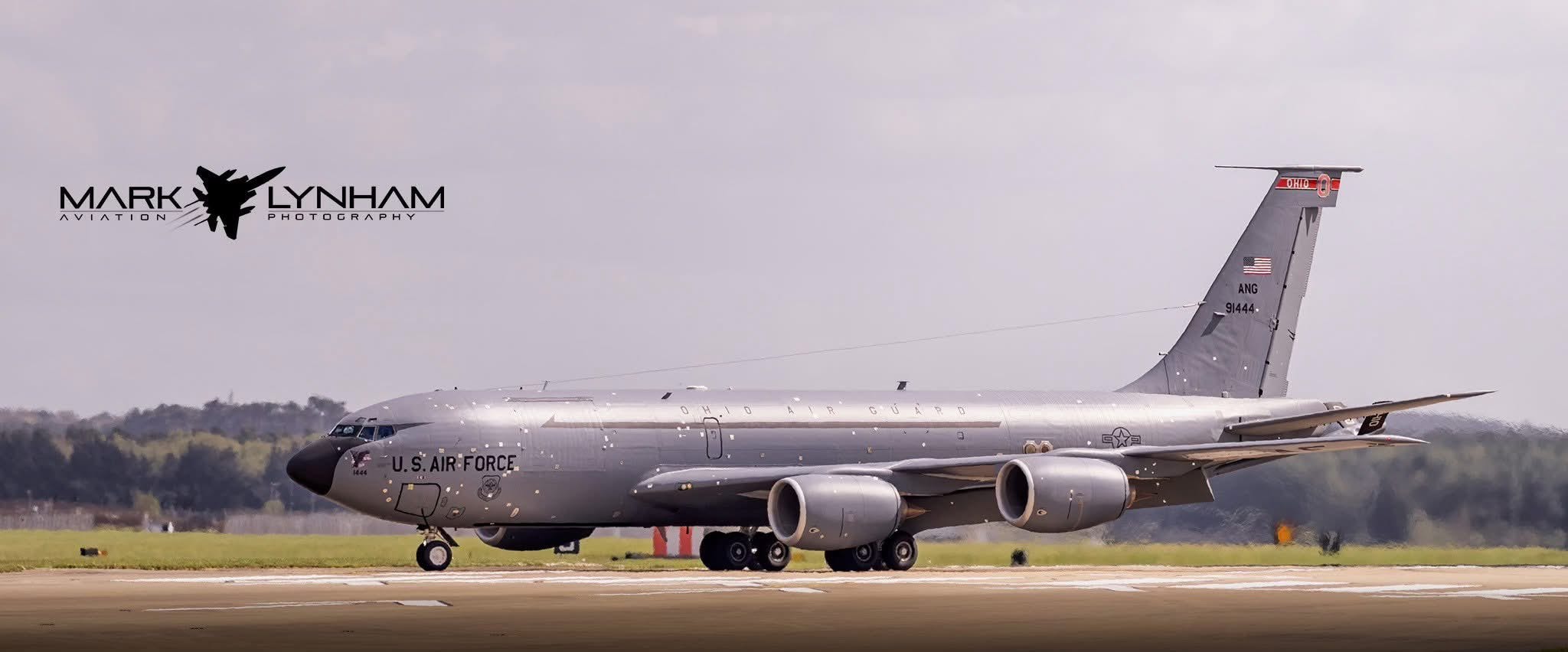
Foremost, and obviously, I’m digressing: it’s entirely unimportant and totally irrelevant - foremost for Ukraine, not to talk about its remaining supporters within the EU (and NATO) - if the president of the USA, and the Prime Minister of Israel are openly cooperating with a Russian megalomaniac that’s running a war of extermination of Ukraine, or a wannabe-dictator blocking the EU’s €90 billion financial aid that’s aiming to keep Kyiv afloat for the next two years…
Only people entirely incapable of seriously analysing warfare would ever come to the idea to start connecting such dots.
Over to Don.
Sumy
The 15th Mobile Border Guard Detachment destroyed a howitzer and other positions.
A Ukrainian airstrike 8 km behind the front lines and a Russian airstrike 2 km behind the front lines.
Russian infiltrators moved 5 km towards Novodmitrovka.
Vovchansk
A Russian rocket launcher is detected while firing 17 km behind the front lines, which leads to its destruction.
Kupiansk
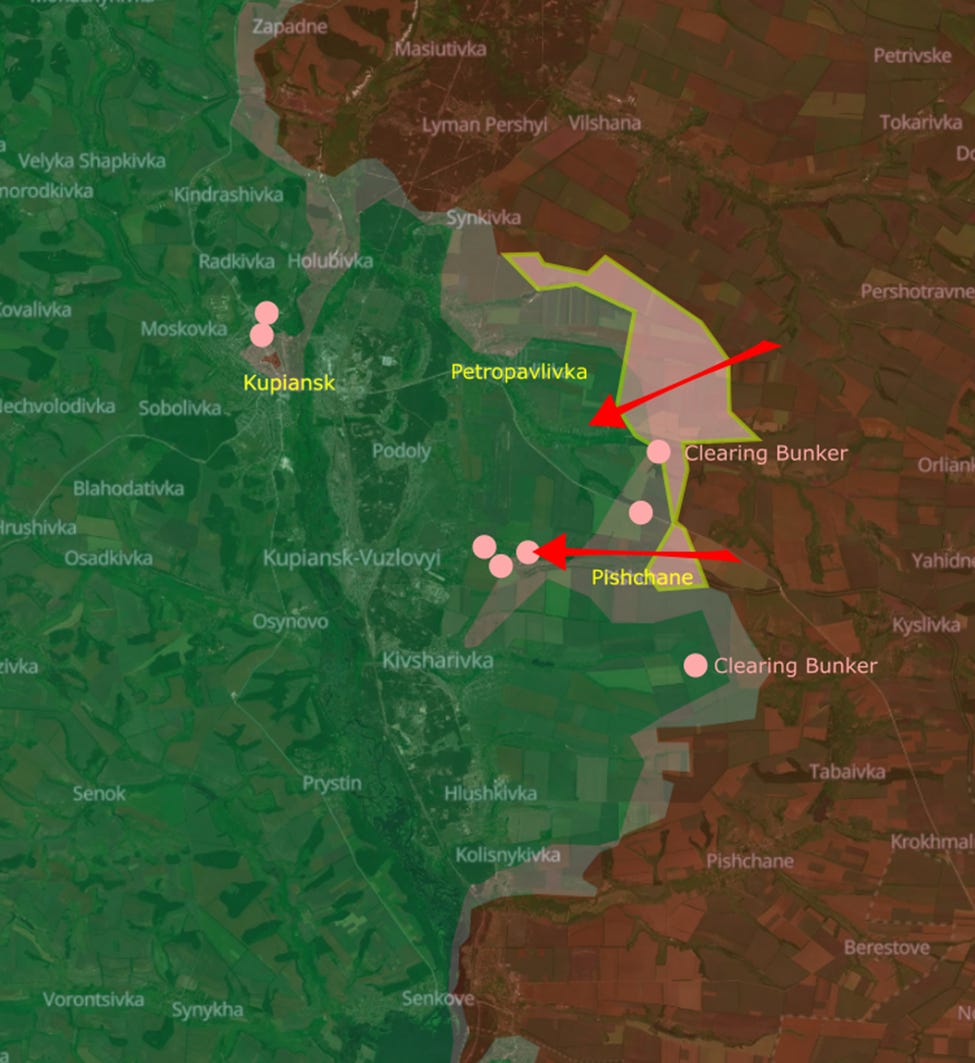
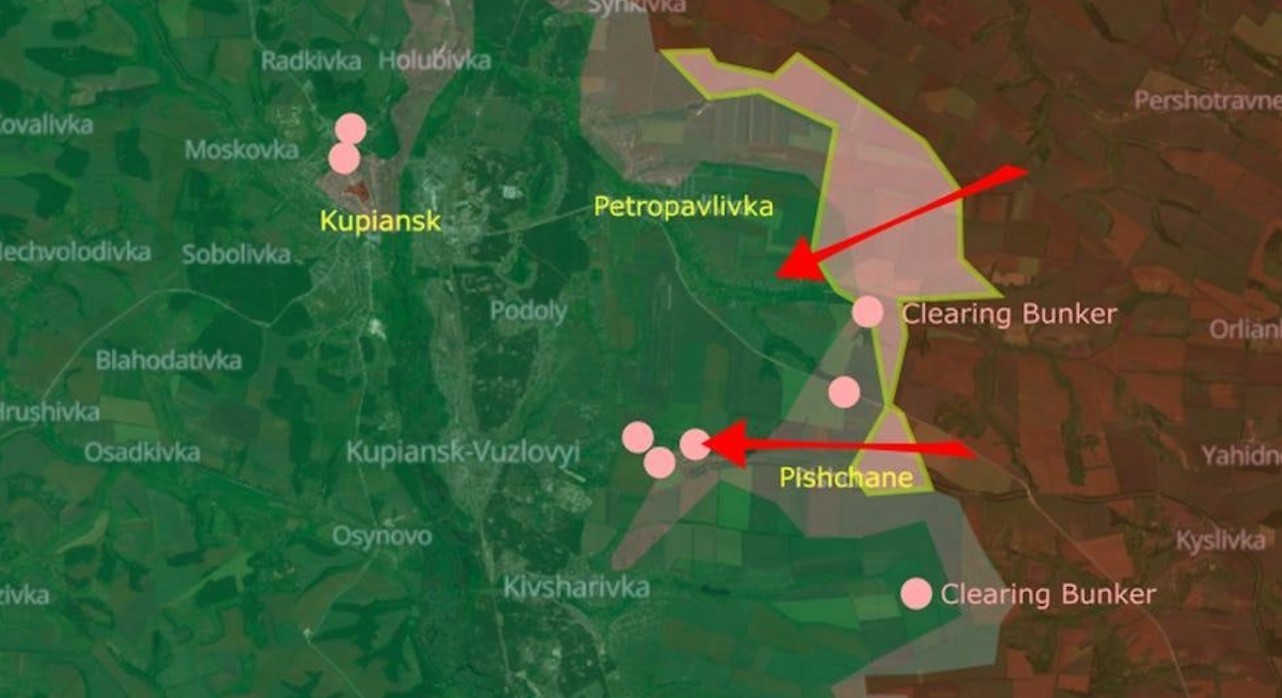
After advancing south of Pishchane last week, Russia advanced into the village and north of it this week,clearing bunkers along the way. It is ten kilometers from the front lines and the Oskil river. As the perimeter shrinks, it will become more difficult to defend east of the river.
Sloviansk
There is still movement in the 11th Corps area centered on Riznykivka, but Russian progress slowed.
10 km from the front, infantry from the 53rd Brigade shoot down a drone.
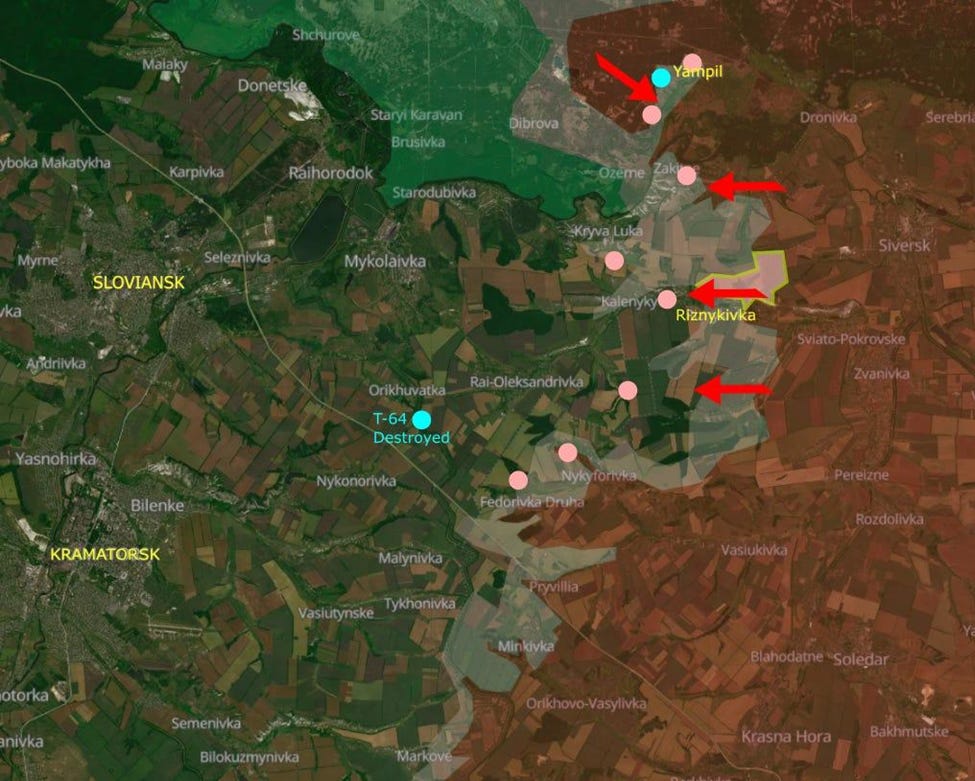
Despite constant Russian attacks, this sector had been stable for 30 months before it started unraveling. Seven months later, Siversk fell. The 54th Mechanized and 10th Mountain brigade commanders were relieved of their command for lying about the situation. The responsibilities of the 11th Corps were reduced to a smaller sector that included the 81st Airmobile Brigade, plus the 54th and 10th brigades. The 11th Corps commander, BG Serhiy Sirchenko, ordered the recapture of Siversk when it was clear that Ukrainian forces couldn’t even stop the Russian advance. In the four months since the fall of Siversk, Russia gained 8 km more.
Sirchenko blamed the brigade commanders for lying when he trusted them, but Russia advanced 10 km in seven months before the commanders were relieved. Or at least taken care to build up their confidence in him through training them on time, so they wouldn’t lie to him. A competent superior officer should also have known exactly why the brigades were being pushed back that far for such a long time. Nah. Instead, it’s simply not him to blame: Sirchenko claimed that he trusted the brigade commanders. Four months after the fall of Siversk, and amid the continuing Russian advance, he was relieved of his command of the 11th Corps.
Kostiantynivka
Engineers set up wire obstacles and detonate Russian mines with drones and charges. Rockets with cluster munitions and airstrikes hit Kostiantynivka often. Most of the anti-drone netting is destroyed just north of the city and a ground drone (UGV) is hit by a Russian drone. This is still better than a truck with a driver being hit. A civilian is killed driving a vehicle 800 meters north of the UGV. A UGV with a casualty is hit.
Multiple Russian infantry are hit and then a Ukrainian airstrike at the end. A Russian UGV is hit 4 km south of Pleshchiivka. Warehouses are hit 70 km behind Russian lines.
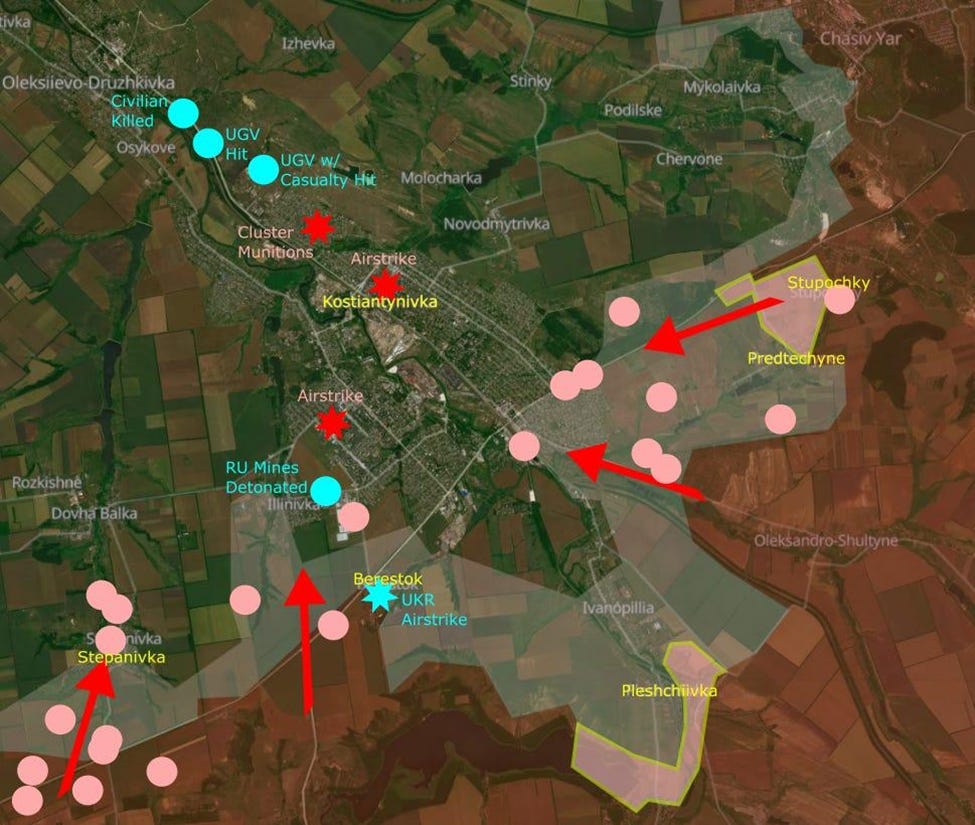
The new obstacle belts exist behind Soviansk, Kramatorsk and Dobropillia. There are some obstacles 8 km in front of Sloviansk and Kramatorsk, but none further east, which is why it is so hard to stop the Russian movement there. Kostiantynivka has a limited amount of obstacles, mostly wire, which is not as durable as trenches. To the west of Kostiantynivka, there are very few obstacles and Russia is making a push in that direction now. If Kostiantynivka was protected by the new obstacle belts, it would be very hard for the Russians to advance.
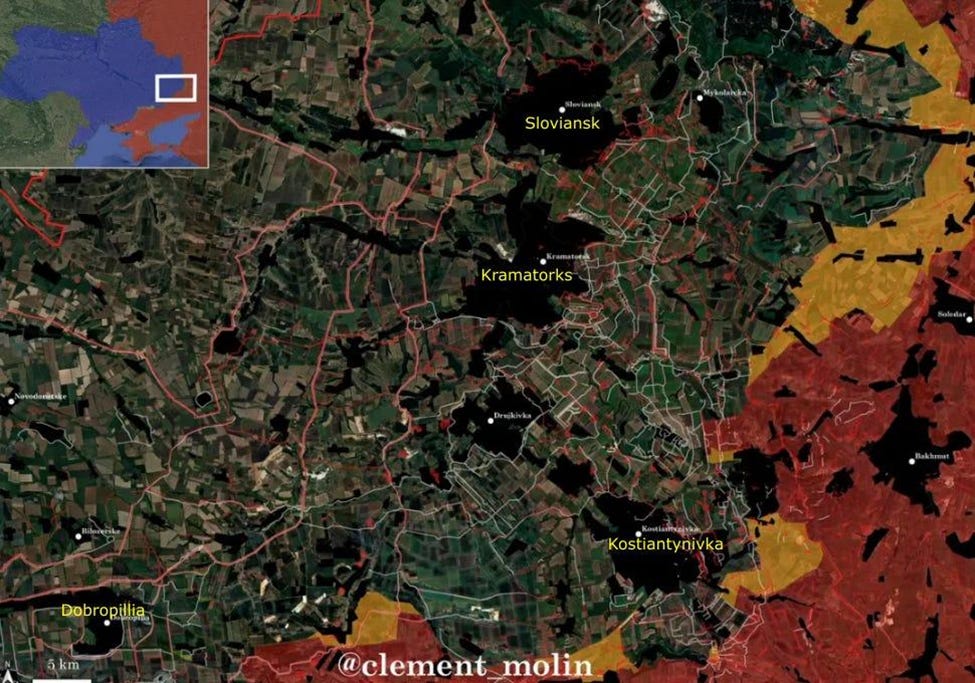
Trenches in red, wire obstacles in white.
Pokrovsk
Three years ago the Russian would move across open terrain in vehicles, or through terrain on foot to reach Ukraine’s defensive positions. Since then, drones on both sides make moving across the open deadly, so Russian attacks tend to advance along terrain features, such as trees and buildings. This is reflected in the advances towards Hryshyne through the trees and buildings, and penetrations along the treelines.
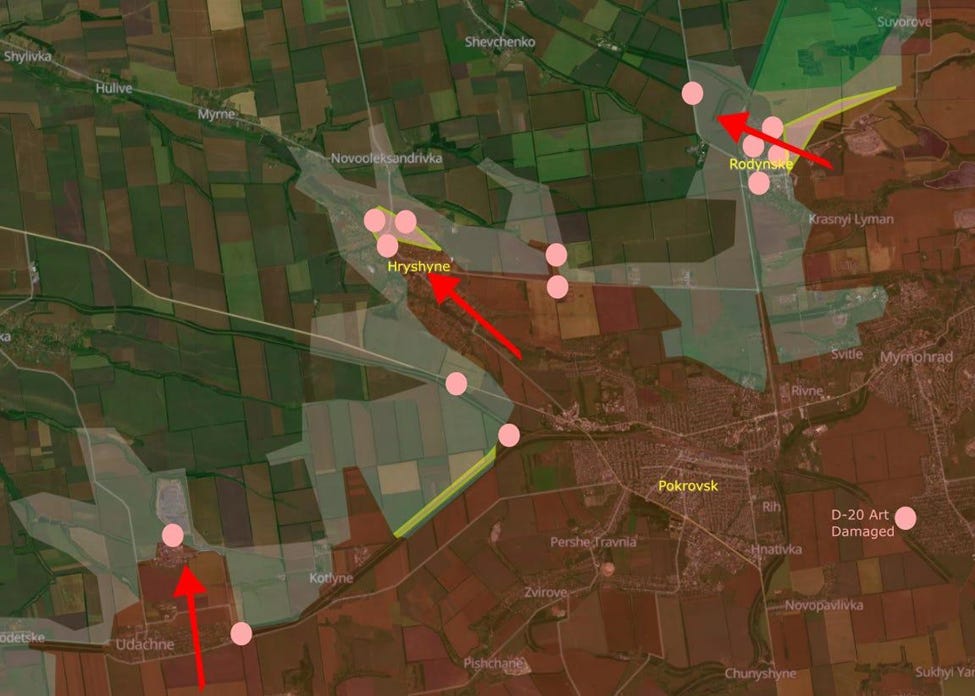
Novopavklivka
A Ukrainian drone with a stick and a string tangles the rotors of Russian drones and brings them down.

(Left) The East Germans created a Death Strip, which blocked citizens from crossing into West Berlin. (Right) Ukraine’s obstacles block vehicles and slow down foot movement in an exposed area making it more likely infantry will be attacked and killed. Some features in the obstacles will degrade over time, such as one row of barbed wire that was broken after a drone killed a Russian. But the degradation would take place over a very long time and any breaches would become a narrow kill zone.
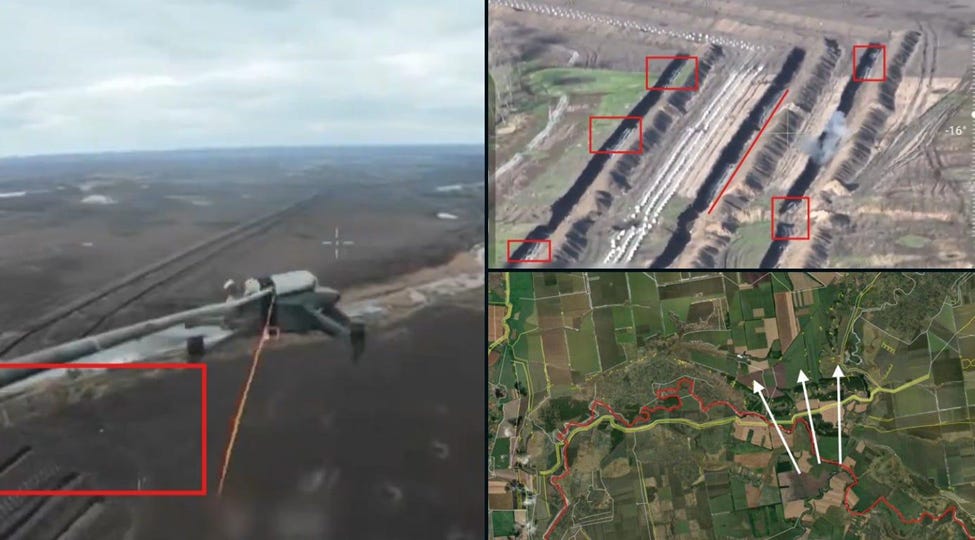
This section of the defenses were never fully completed. (Left) The trenches weren’t extended to the river. (Top Right) No wire was placed in the first trench. There are already multiple holes from previous attacks. It remains a formidable obstacle. (Bottom Right) The river (in red) is a natural defensive barrier. This line has already been held for eight months and is still in very good condition.
Huliaipole
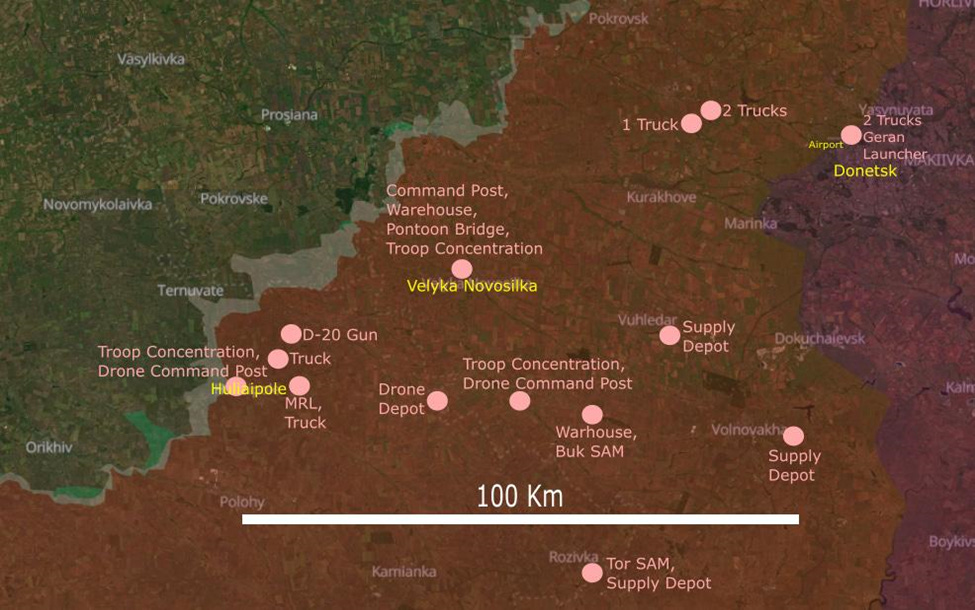
There was no reported change in territory, although the infiltration and attrition continued. This is a good time to show just a portion of the deep strikes that are taking place in this sector. Notice that the Buk and Tor air defense systems were guarding supply depots 60 and 80 km from the front, respectively. Both systems and the supplies they were guarding were hit.
The troop concentrations that were hit were all on major roads and in villages or towns. They also had command posts for troops or drones. Drone or supply depots were also hit.
These are just videos that were available to the public. It shows how Ukraine is trying to slow the movement of troops and supplies to the front with attacks with winged drones. FP-1 drones were used in many of these attacks. They have a 1600 km range with 50-120 kg warheads. At these short distances, they could all use 120 kg warheads if that was appropriate for the target.
With the rate of movement for infantry and supplies slowed down, there is more time for the FPV drones to take out the reduced rate of infiltrating Russian troops. Their attack will be more thorough with less chance of Russian infantry slipping through. If there were movement obstacles, Russian movement would be even slower.
This text is published with the permission of the author. First published here.




.jpeg)